Leader's Digest
The Last-Mile Compliance Audit: Navigating ANZ Safety Standards in 2026
Published: Jan 31, 2024
4 Min Read
As we enter the mid-point of 2026, the Australian and New Zealand logistics regulatory landscape is shifting from reactive enforcement to proactive, data-driven accountability. For fleet managers and logistics providers, “near enough” is no longer good enough.
With the Heavy Vehicle National Law (HVNL) Amendment Bill 2025 scheduled to commence in mid-2026, the stakes for compliance have never been higher. This isn’t just about avoiding fines; it’s about your Chain of Responsibility (CoR) and your brand’s social license to operate.
This guide breaks down the essential compliance pillars you need to master to remain audit-ready in the current regulatory climate.
1. The 2026 HVNL Amendments: What’s Changing?
The most significant shift in Australian transport law is the modernisation of the Heavy Vehicle National Law. The 2025/2026 amendment package introduces a streamlined Heavy Vehicle Accreditation (HVA) scheme, consolidating four previous schemes into two: General Safety Accreditation and Alternative Compliance Accreditation.
Key Regulatory Shifts include
Safety Management Systems (SMS): Under the new General Safety Accreditation, a comprehensive SMS is no longer a “nice to have”—it is a core requirement.
Admissible Audits: Audits conducted by approved auditors can now be used as evidence in court proceedings for breaches of primary safety duties. If your data is messy, your audit becomes a liability rather than a defence.
Expanded ‘Unfit to Drive’ Obligations: New provisions now apply to all heavy vehicle drivers over 4.5 tonnes, not just those over 12 tonnes. This covers physical illness, mental health, and general fitness for duty. 2. Mastering the Chain of Responsib
2. Mastering the Chain of Responsibility (CoR)
In both Australia and New Zealand, the Chain of Responsibility ensures that anyone who has control over the transport task—not just the driver—can be held responsible for safety breaches. In 2026, the National Heavy Vehicle Regulator (NHVR) is increasing transparency via tools like NHVR Go, which gives operators direct visibility of their fleet’s intercept and non-compliance data in real-time. This means the regulator knows your fleet’s performance as well as you do—and they expect you to act on that data immediately.
How to Stay Compliant:
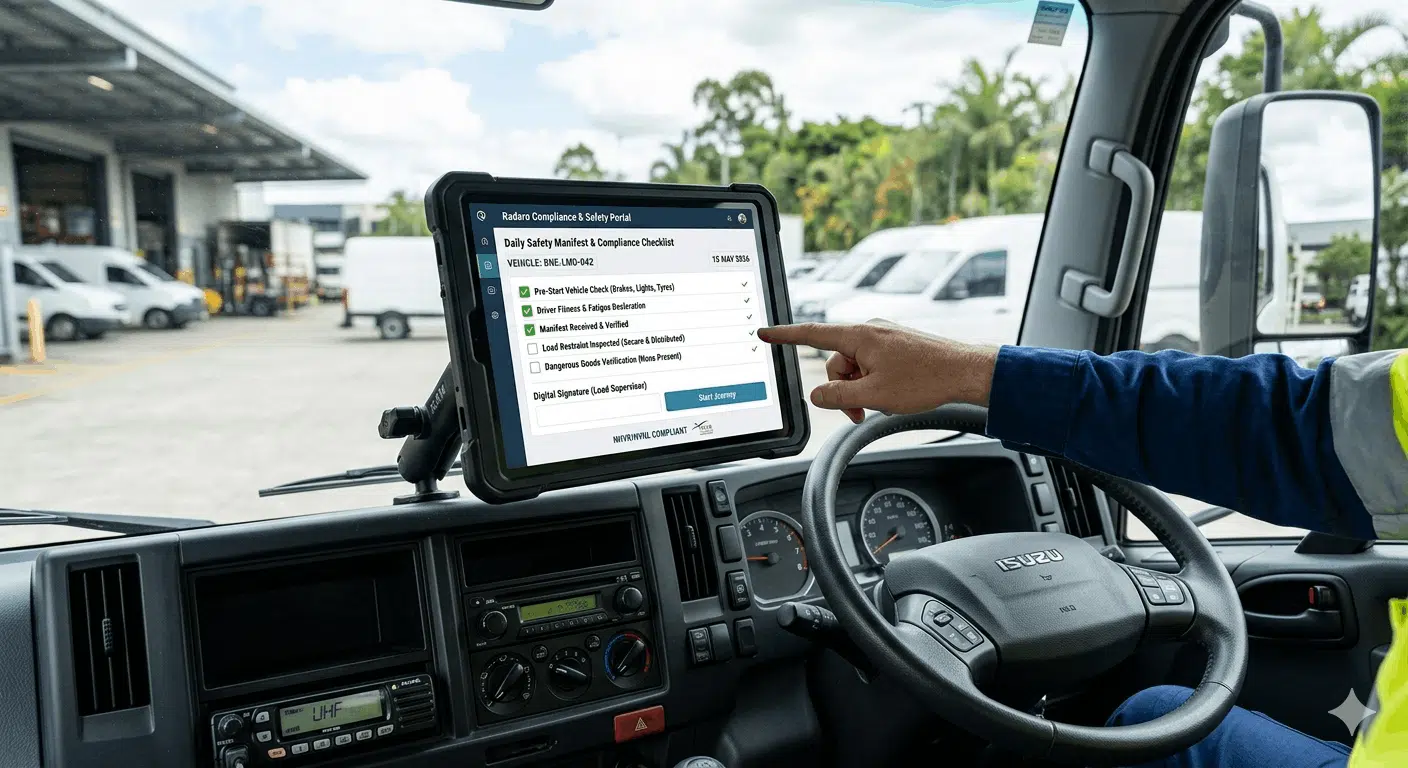
Automated Pre-Start Checks: Manual paper logs are prone to error and pencil-whipping. Digital checklists ensure that a vehicle doesn’t leave the yard unless it meets safety standards.
Real-Time Fatigue Monitoring: Fatigue contributes to up to 30% of severe heavy vehicle crashes. Modern systems must now track work-rest hours dynamically rather than relying on manual diary entries.
3. The Digital Manifest: Your Best Audit Defence
One of the primary friction points in a compliance audit is the paper trail. In New Zealand, Waka Kotahi (NZTA) is increasingly reviewing vehicle regulatory systems to improve safety performance while reducing regulatory burden through digital integration.
A digital manifest does more than track a parcel; it serves as a time-stamped, unalterable record of the entire delivery lifecycle.
Load Restraint: Digital records can include photographic evidence of load securing, a key requirement under the NZ Certificate of Fitness (CoF) standards.
Incident Reporting: If a roadside intercept occurs, having instant access to vehicle registration, VIN, and driver fitness declarations via a mobile platform can turn a high-stress event into a routine check.
4. Why Last-Mile Compliance is Different
Unlike long-haul trucking, last-mile delivery involves high-frequency stops, urban congestion, and often, a mix of heavy and light vehicles. The Unfit to Drive expansion is particularly relevant here. Last-mile drivers face unique stressors, from navigating tight suburban streets to managing high customer expectations. Operators must now demonstrate they are monitoring driver wellbeing and “fitness for duty” before every shift, not just once a year.
5. Technology as a Compliance Partner, Not a Burden
The biggest challenge for logistics managers is implementing these standards without slowing down operations. This is where Radaro’s Compliance, Safety and Process Module steps in.
Instead of adding administrative hurdles, the right software embeds compliance into the driver’s natural workflow:
Conditional Logic Checklists: Driver checklists are configurable to capture additional information based on responses.
Platform Lockouts: If a driver fails a “Fit for Duty” declaration or misses a critical safety check, the system can automatically lock the driver out of their manifest until a manager reviews the case.
Multiple response types: From barcodes to digital signatures and photos, every piece of data is time-stamped and stored for easy retrieval during an NHVR or NZTA audit.
Conclusion: Are You Audit-Ready?
As we head toward the mid-2026 commencement of the new HVNL laws, the message from regulators is clear: Data is the new currency of safety.
Companies that rely on fragmented, paper-based systems are carrying a significant legal risk. By transitioning to a unified digital platform that manages fatigue, vehicle maintenance, and driver fitness in one place, you aren’t just ticking a box—you’re building a fundamentally safer, more resilient business.
Don’t wait for an intercept to find out where your gaps are. Conduct your own Last-Mile Audit today and ensure your fleet is prepared for the new era of AU/NZ transport compliance.
Compliance Checklist for 2026
Update your SMS: Ensure it aligns with the NHVR’s new General Safety Accreditation standards.
Digitise Pre-Starts: Eliminate paper logs for vehicle inspections and fitness-for-duty checks.
Monitor NHVR Go: Regularly check your fleet’s intercept data to identify patterns of non-compliance.
Train Your Chain: Ensure managers and dispatchers understand their legal liability under CoR laws.
Automate Records: Ensure all manifests, signatures, and photos are archived and searchable for at least 7 years.
Subscribe to our Newsletter


Get Started with Radaro
Last mile delivery software designed for complex, real-world logistics.


As we enter the mid-point of 2026, the Australian and New Zealand logistics regulatory landscape is shifting from reactive enforcement to proactive, data-driven accountability. For fleet managers and logistics providers, “near enough” is no longer good enough.
With the Heavy Vehicle National Law (HVNL) Amendment Bill 2025 scheduled to commence in mid-2026, the stakes for compliance have never been higher. This isn’t just about avoiding fines; it’s about your Chain of Responsibility (CoR) and your brand’s social license to operate.
This guide breaks down the essential compliance pillars you need to master to remain audit-ready in the current regulatory climate.
1. The 2026 HVNL Amendments: What’s Changing?
The most significant shift in Australian transport law is the modernisation of the Heavy Vehicle National Law. The 2025/2026 amendment package introduces a streamlined Heavy Vehicle Accreditation (HVA) scheme, consolidating four previous schemes into two: General Safety Accreditation and Alternative Compliance Accreditation.
Key Regulatory Shifts include
Safety Management Systems (SMS): Under the new General Safety Accreditation, a comprehensive SMS is no longer a “nice to have”—it is a core requirement.
Admissible Audits: Audits conducted by approved auditors can now be used as evidence in court proceedings for breaches of primary safety duties. If your data is messy, your audit becomes a liability rather than a defence.
Expanded ‘Unfit to Drive’ Obligations: New provisions now apply to all heavy vehicle drivers over 4.5 tonnes, not just those over 12 tonnes. This covers physical illness, mental health, and general fitness for duty. 2. Mastering the Chain of Responsib
2. Mastering the Chain of Responsibility (CoR)
In both Australia and New Zealand, the Chain of Responsibility ensures that anyone who has control over the transport task—not just the driver—can be held responsible for safety breaches. In 2026, the National Heavy Vehicle Regulator (NHVR) is increasing transparency via tools like NHVR Go, which gives operators direct visibility of their fleet’s intercept and non-compliance data in real-time. This means the regulator knows your fleet’s performance as well as you do—and they expect you to act on that data immediately.
How to Stay Compliant:
Automated Pre-Start Checks: Manual paper logs are prone to error and pencil-whipping. Digital checklists ensure that a vehicle doesn’t leave the yard unless it meets safety standards.
Real-Time Fatigue Monitoring: Fatigue contributes to up to 30% of severe heavy vehicle crashes. Modern systems must now track work-rest hours dynamically rather than relying on manual diary entries.
3. The Digital Manifest: Your Best Audit Defence
One of the primary friction points in a compliance audit is the paper trail. In New Zealand, Waka Kotahi (NZTA) is increasingly reviewing vehicle regulatory systems to improve safety performance while reducing regulatory burden through digital integration.
A digital manifest does more than track a parcel; it serves as a time-stamped, unalterable record of the entire delivery lifecycle.
Load Restraint: Digital records can include photographic evidence of load securing, a key requirement under the NZ Certificate of Fitness (CoF) standards.
Incident Reporting: If a roadside intercept occurs, having instant access to vehicle registration, VIN, and driver fitness declarations via a mobile platform can turn a high-stress event into a routine check.
4. Why Last-Mile Compliance is Different
Unlike long-haul trucking, last-mile delivery involves high-frequency stops, urban congestion, and often, a mix of heavy and light vehicles. The Unfit to Drive expansion is particularly relevant here. Last-mile drivers face unique stressors, from navigating tight suburban streets to managing high customer expectations. Operators must now demonstrate they are monitoring driver wellbeing and “fitness for duty” before every shift, not just once a year.
5. Technology as a Compliance Partner, Not a Burden
The biggest challenge for logistics managers is implementing these standards without slowing down operations. This is where Radaro’s Compliance, Safety and Process Module steps in.
Instead of adding administrative hurdles, the right software embeds compliance into the driver’s natural workflow:
Conditional Logic Checklists: Driver checklists are configurable to capture additional information based on responses.
Platform Lockouts: If a driver fails a “Fit for Duty” declaration or misses a critical safety check, the system can automatically lock the driver out of their manifest until a manager reviews the case.
Multiple response types: From barcodes to digital signatures and photos, every piece of data is time-stamped and stored for easy retrieval during an NHVR or NZTA audit.
Conclusion: Are You Audit-Ready?
As we head toward the mid-2026 commencement of the new HVNL laws, the message from regulators is clear: Data is the new currency of safety.
Companies that rely on fragmented, paper-based systems are carrying a significant legal risk. By transitioning to a unified digital platform that manages fatigue, vehicle maintenance, and driver fitness in one place, you aren’t just ticking a box—you’re building a fundamentally safer, more resilient business.
Don’t wait for an intercept to find out where your gaps are. Conduct your own Last-Mile Audit today and ensure your fleet is prepared for the new era of AU/NZ transport compliance.
Compliance Checklist for 2026
Update your SMS: Ensure it aligns with the NHVR’s new General Safety Accreditation standards.
Digitise Pre-Starts: Eliminate paper logs for vehicle inspections and fitness-for-duty checks.
Monitor NHVR Go: Regularly check your fleet’s intercept data to identify patterns of non-compliance.
Train Your Chain: Ensure managers and dispatchers understand their legal liability under CoR laws.
Automate Records: Ensure all manifests, signatures, and photos are archived and searchable for at least 7 years.
Subscribe to our Newsletter
Get Started with Radaro
Last mile delivery software designed for complex, real-world logistics.
Related Posts
Related Posts
Leader's Digest Insights


Take Control of Your Last Mile
Discover what Radaro can do for you



"/><stop offset="1" stop-color="rgba(114, 163, 190, 0)"/></linearGradient></defs><g d="M 72 37.3 L 96.4 37.3 C 98.6 37.3 100.4 35.7 100.6 33.5 C 100.8 31.3 101.2 27.1 101.2 22.2 C 101.2 17.3 101 14.4 100.7 12.1 C 100.4 9.8 98.7 8.4 96.5 8.4 L 72 8.4 L 72 37.2 Z M 80 30.3 L 77.3 30.3 L 77.3 4.9 L 80 4.9 Z M 71 5.1 C 71.552 5.1 72 5.548 72 6.1 L 72 37.6 C 72 38.152 71.552 38.6 71 38.6 L 1 38.6 C 0.448 38.6 0 38.152 0 37.6 L 0 6.1 C 0 5.548 0.448 5.1 1 5.1 Z M 97.5 37.1 L 5.2 37.1 L 5.2 27.3 L 100.5 27.3 L 100.5 34.1 C 100.5 35.8 99.2 37.1 97.5 37.1 Z M 79.5 31.7 L 99.4 31.7 C 101.6 31.7 103.4 30.1 103.6 27.9 C 103.8 25.7 104.2 21.5 104.2 16.6 C 104.2 12.1 104 8.8 103.7 6.5 C 103.4 4.2 101.7 2.8 99.5 2.8 L 79.5 2.8 L 79.5 31.6 Z M 88.7 28.2 L 94.3 29.3 L 102 30.8 C 101.3 31.3 100.4 31.7 99.4 31.7 L 79.5 31.7 L 79.5 28.2 Z M 76.4 1.2 C 76.952 1.2 77.4 1.648 77.4 2.2 L 77.4 31.9 C 77.4 32.452 76.952 32.9 76.4 32.9 L 6.4 32.9 C 5.848 32.9 5.4 32.452 5.4 31.9 L 5.4 2.2 C 5.4 1.648 5.848 1.2 6.4 1.2 Z M 76.9 32.7 L 5.7 32.7 L 5.7 31.1 L 76.9 31.1 Z M 76.4 1.2 C 76.952 1.2 77.4 1.648 77.4 2.2 L 77.4 31.9 C 77.4 32.452 76.952 32.9 76.4 32.9 L 6.4 32.9 C 5.848 32.9 5.4 32.452 5.4 31.9 L 5.4 2.2 C 5.4 1.648 5.848 1.2 6.4 1.2 Z M 89.3 5.4 C 89 5.4 88.9 5.7 89 6 C 89.5 7.4 91 11.9 91 17.1 C 91 22.3 89.6 26.5 89 27.9 C 88.4 29.3 89 28.4 89.3 28.5 L 93.9 29.2 C 94.3 29.2 94.7 29 94.8 28.7 C 95.4 27.2 96.9 22.9 96.9 17 C 96.9 11.1 95.4 6.7 94.7 5.2 C 94 3.7 94.2 4.6 93.8 4.7 L 89.2 5.5 Z M 85.7 5.1 L 82.1 5.1 C 81.8 5.1 81.6 4.9 81.6 4.6 L 81.6 4.4 C 81.6 4.1 81.8 3.9 82.1 3.9 L 91.9 3.9 L 86.8 5 C 86.4 5 86.1 5.1 85.7 5.1 Z M 85.6 29.2 L 81.9 29.2 C 81.7 29.2 81.5 29.4 81.5 29.6 L 81.5 30 C 81.5 30.2 81.7 30.4 81.9 30.4 L 91.8 30.4 L 86.7 29.3 C 86.3 29.3 85.9 29.2 85.6 29.2 Z M 104.2 16.9 C 104.2 20 104.1 22.6 103.9 24.8 C 103.2 24.7 102.8 24.1 102.8 23.4 L 102.8 11.1 C 102.8 10.4 103.3 9.8 103.9 9.7 C 104 11.6 104.1 14 104.1 16.9 Z M 99.6 3.3 L 100.2 2.9 C 102 3.2 103.5 4.7 103.7 6.6 L 103.7 7 C 103.4 7.2 103.1 7.1 103 7 C 102.7 6.2 101.8 4.8 99.6 4.1 C 99.3 4.1 99.3 3.6 99.6 3.4 Z M 99.6 31.1 L 100.2 31.5 C 102 31.2 103.5 29.7 103.7 27.8 L 103.7 27.4 C 103.4 27.2 103.1 27.3 103 27.4 C 102.7 28.2 101.8 29.6 99.6 30.3 C 99.3 30.3 99.3 30.8 99.6 31 Z M 89.7 2.8 L 88.4 1 C 88.3 0.8 88.4 0.6 88.5 0.4 L 89.1 0 C 89.5 0 89.9 0.2 90.2 0.6 L 90.6 1.2 C 90.9 1.6 91 2.1 91 2.5 L 91 3.7 L 89.7 3.7 L 89.7 2.7 Z M 89.7 31.4 L 88.4 33.2 C 88.3 33.4 88.4 33.6 88.5 33.8 L 89.1 34.2 C 89.5 34.2 89.9 34 90.2 33.6 L 90.6 33 C 90.9 32.6 91 32.1 91 31.7 L 91 30.5 L 89.7 30.5 L 89.7 31.5 Z" fill="transparent" height="38.599999904632575px" id="LuoQ0xnNj" width="104.20000000000002px"><g d="M 72 37.3 L 96.4 37.3 C 98.6 37.3 100.4 35.7 100.6 33.5 C 100.8 31.3 101.2 27.1 101.2 22.2 C 101.2 17.3 101 14.4 100.7 12.1 C 100.4 9.8 98.7 8.4 96.5 8.4 L 72 8.4 L 72 37.2 Z M 80 30.3 L 77.3 30.3 L 77.3 4.9 L 80 4.9 Z M 71 5.1 C 71.552 5.1 72 5.548 72 6.1 L 72 37.6 C 72 38.152 71.552 38.6 71 38.6 L 1 38.6 C 0.448 38.6 0 38.152 0 37.6 L 0 6.1 C 0 5.548 0.448 5.1 1 5.1 Z M 97.5 37.1 L 5.2 37.1 L 5.2 27.3 L 100.5 27.3 L 100.5 34.1 C 100.5 35.8 99.2 37.1 97.5 37.1 Z M 79.5 31.7 L 99.4 31.7 C 101.6 31.7 103.4 30.1 103.6 27.9 C 103.8 25.7 104.2 21.5 104.2 16.6 C 104.2 12.1 104 8.8 103.7 6.5 C 103.4 4.2 101.7 2.8 99.5 2.8 L 79.5 2.8 L 79.5 31.6 Z M 88.7 28.2 L 94.3 29.3 L 102 30.8 C 101.3 31.3 100.4 31.7 99.4 31.7 L 79.5 31.7 L 79.5 28.2 Z M 76.4 1.2 C 76.952 1.2 77.4 1.648 77.4 2.2 L 77.4 31.9 C 77.4 32.452 76.952 32.9 76.4 32.9 L 6.4 32.9 C 5.848 32.9 5.4 32.452 5.4 31.9 L 5.4 2.2 C 5.4 1.648 5.848 1.2 6.4 1.2 Z M 76.9 32.7 L 5.7 32.7 L 5.7 31.1 L 76.9 31.1 Z M 76.4 1.2 C 76.952 1.2 77.4 1.648 77.4 2.2 L 77.4 31.9 C 77.4 32.452 76.952 32.9 76.4 32.9 L 6.4 32.9 C 5.848 32.9 5.4 32.452 5.4 31.9 L 5.4 2.2 C 5.4 1.648 5.848 1.2 6.4 1.2 Z M 89.3 5.4 C 89 5.4 88.9 5.7 89 6 C 89.5 7.4 91 11.9 91 17.1 C 91 22.3 89.6 26.5 89 27.9 C 88.4 29.3 89 28.4 89.3 28.5 L 93.9 29.2 C 94.3 29.2 94.7 29 94.8 28.7 C 95.4 27.2 96.9 22.9 96.9 17 C 96.9 11.1 95.4 6.7 94.7 5.2 C 94 3.7 94.2 4.6 93.8 4.7 L 89.2 5.5 Z M 85.7 5.1 L 82.1 5.1 C 81.8 5.1 81.6 4.9 81.6 4.6 L 81.6 4.4 C 81.6 4.1 81.8 3.9 82.1 3.9 L 91.9 3.9 L 86.8 5 C 86.4 5 86.1 5.1 85.7 5.1 Z M 85.6 29.2 L 81.9 29.2 C 81.7 29.2 81.5 29.4 81.5 29.6 L 81.5 30 C 81.5 30.2 81.7 30.4 81.9 30.4 L 91.8 30.4 L 86.7 29.3 C 86.3 29.3 85.9 29.2 85.6 29.2 Z M 104.2 16.9 C 104.2 20 104.1 22.6 103.9 24.8 C 103.2 24.7 102.8 24.1 102.8 23.4 L 102.8 11.1 C 102.8 10.4 103.3 9.8 103.9 9.7 C 104 11.6 104.1 14 104.1 16.9 Z M 99.6 3.3 L 100.2 2.9 C 102 3.2 103.5 4.7 103.7 6.6 L 103.7 7 C 103.4 7.2 103.1 7.1 103 7 C 102.7 6.2 101.8 4.8 99.6 4.1 C 99.3 4.1 99.3 3.6 99.6 3.4 Z M 99.6 31.1 L 100.2 31.5 C 102 31.2 103.5 29.7 103.7 27.8 L 103.7 27.4 C 103.4 27.2 103.1 27.3 103 27.4 C 102.7 28.2 101.8 29.6 99.6 30.3 C 99.3 30.3 99.3 30.8 99.6 31 Z M 89.7 2.8 L 88.4 1 C 88.3 0.8 88.4 0.6 88.5 0.4 L 89.1 0 C 89.5 0 89.9 0.2 90.2 0.6 L 90.6 1.2 C 90.9 1.6 91 2.1 91 2.5 L 91 3.7 L 89.7 3.7 L 89.7 2.7 Z M 89.7 31.4 L 88.4 33.2 C 88.3 33.4 88.4 33.6 88.5 33.8 L 89.1 34.2 C 89.5 34.2 89.9 34 90.2 33.6 L 90.6 33 C 90.9 32.6 91 32.1 91 31.7 L 91 30.5 L 89.7 30.5 L 89.7 31.5 Z" fill="transparent" height="38.599999904632575px" id="zezgG8Y1q" width="104.20000000000002px"><g opacity="0.4"><path d="M 0 28.9 L 24.4 28.9 C 26.6 28.9 28.4 27.3 28.6 25.1 C 28.8 22.9 29.2 18.7 29.2 13.8 C 29.2 8.9 29 6 28.7 3.7 C 28.4 1.4 26.7 0 24.5 0 L 0 0 L 0 28.8 Z" fill="rgb(215, 227, 232)" height="28.900000000000006px" id="m6px2y2al" transform="translate(72 8.4)" width="29.19999999999999px"/></g><path d="M 2.7 25.4 L 0 25.4 L 0 0 L 2.7 0 Z" fill="rgb(7, 64, 89)" height="25.4px" id="cyMhIGwIO" transform="translate(77.3 4.9)" width="2.700000000000017px"/><g opacity="0.4"><path d="M 71 0 C 71.552 0 72 0.448 72 1 L 72 32.5 C 72 33.052 71.552 33.5 71 33.5 L 1 33.5 C 0.448 33.5 0 33.052 0 32.5 L 0 1 C 0 0.448 0.448 0 1 0 Z" fill="rgb(215, 227, 232)" height="33.50000000000001px" id="V9wSu3WkR" transform="translate(0 5.1)" width="72px"/></g><g opacity="0.8"><path d="M 92.3 9.8 L 0 9.8 L 0 0 L 95.3 0 L 95.3 6.8 C 95.3 8.5 94 9.8 92.3 9.8 Z" fill="url(%23NPpo5c7u7-389490388-linear-gradient)" height="9.800000000000011px" id="NPpo5c7u7" transform="translate(5.2 27.3)" width="95.29999999999998px"/></g><path d="M 0 28.9 L 19.9 28.9 C 22.1 28.9 23.9 27.3 24.1 25.1 C 24.3 22.9 24.7 18.7 24.7 13.8 C 24.7 9.3 24.5 6 24.2 3.7 C 23.9 1.4 22.2 0 20 0 L 0 0 L 0 28.8 Z" fill="rgb(215, 227, 232)" height="28.9px" id="QiYhvoPI2" transform="translate(79.5 2.8)" width="24.700000000000017px"/><g opacity="0.4"><path d="M 9.2 0 L 14.8 1.1 L 22.5 2.6 C 21.8 3.1 20.9 3.5 19.9 3.5 L 0 3.5 L 0 0 Z" fill="rgb(114, 163, 190)" height="3.5px" id="iw09x_5cV" transform="translate(79.5 28.2)" width="22.5px"/></g><path d="M 71 0 C 71.552 0 72 0.448 72 1 L 72 30.7 C 72 31.252 71.552 31.7 71 31.7 L 1 31.7 C 0.448 31.7 0 31.252 0 30.7 L 0 1 C 0 0.448 0.448 0 1 0 Z" fill="rgb(249, 250, 252)" height="31.70000000000001px" id="enHG0Xv5x" transform="translate(5.4 1.2)" width="71.99999999999999px"/><g opacity="0.4"><path d="M 71.2 1.6 L 0 1.6 L 0 0 L 71.2 0 Z" fill="rgb(114, 163, 190)" height="1.6000000000000156px" id="nNlyDyI8O" transform="translate(5.7 31.1)" width="71.20000000000002px"/></g><path d="M 71 0 C 71.552 0 72 0.448 72 1 L 72 30.7 C 72 31.252 71.552 31.7 71 31.7 L 1 31.7 C 0.448 31.7 0 31.252 0 30.7 L 0 1 C 0 0.448 0.448 0 1 0 Z" fill="transparent" height="31.70000000000001px" id="fXaCrMspo" stroke-dasharray="" stroke-linecap="butt" stroke-linejoin="miter" stroke-miterlimit="10" stroke-width="1" stroke="rgb(215, 227, 232)" transform="translate(5.4 1.2)" width="71.99999999999999px"/><path d="M 7.8 1.5 C 7.5 1.5 7.4 1.8 7.5 2.1 C 8 3.5 9.5 8 9.5 13.2 C 9.5 18.4 8.1 22.6 7.5 24 C 6.9 25.4 7.5 24.5 7.8 24.6 L 12.4 25.3 C 12.8 25.3 13.2 25.1 13.3 24.8 C 13.9 23.3 15.4 19 15.4 13.1 C 15.4 7.2 13.9 2.8 13.2 1.3 C 12.5 -0.2 12.7 0.7 12.3 0.8 L 7.7 1.6 Z M 4.2 1.2 L 0.6 1.2 C 0.3 1.2 0.1 1 0.1 0.7 L 0.1 0.5 C 0.1 0.2 0.3 0 0.6 0 L 10.4 0 L 5.3 1.1 C 4.9 1.1 4.6 1.2 4.2 1.2 Z M 4.1 25.3 L 0.4 25.3 C 0.2 25.3 0 25.5 0 25.7 L 0 26.1 C 0 26.3 0.2 26.5 0.4 26.5 L 10.3 26.5 L 5.2 25.4 C 4.8 25.4 4.4 25.3 4.1 25.3 Z M 22.7 13 C 22.7 16.1 22.6 18.7 22.4 20.9 C 21.7 20.8 21.3 20.2 21.3 19.5 L 21.3 7.2 C 21.3 6.5 21.8 5.9 22.4 5.8 C 22.5 7.7 22.6 10.1 22.6 13 Z" fill="rgb(7, 64, 89)" height="26.499999237060543px" id="zg2puoduN" transform="translate(81.5 3.9)" width="22.699999237060524px"/><path d="M 0.225 0.4 L 0.825 0 C 2.625 0.3 4.125 1.8 4.325 3.7 L 4.325 4.1 C 4.025 4.3 3.725 4.2 3.625 4.1 C 3.325 3.3 2.425 1.9 0.225 1.2 C -0.075 1.2 -0.075 0.7 0.225 0.5 Z M 0.225 28.2 L 0.825 28.6 C 2.625 28.3 4.125 26.8 4.325 24.9 L 4.325 24.5 C 4.025 24.3 3.725 24.4 3.625 24.5 C 3.325 25.3 2.425 26.7 0.225 27.4 C -0.075 27.4 -0.075 27.9 0.225 28.1 Z" fill="rgb(255, 184, 41)" height="28.599999167607464px" id="yJQ3TgwJ6" transform="translate(99.375 2.9)" width="4.325000000000017px"/><path d="M 1.341 2.8 L 0.041 1 C -0.059 0.8 0.041 0.6 0.141 0.4 L 0.741 0 C 1.141 0 1.541 0.2 1.841 0.6 L 2.241 1.2 C 2.541 1.6 2.641 2.1 2.641 2.5 L 2.641 3.7 L 1.341 3.7 L 1.341 2.7 Z M 1.341 31.4 L 0.041 33.2 C -0.059 33.4 0.041 33.6 0.141 33.8 L 0.741 34.2 C 1.141 34.2 1.541 34 1.841 33.6 L 2.241 33 C 2.541 32.6 2.641 32.1 2.641 31.7 L 2.641 30.5 L 1.341 30.5 L 1.341 31.5 Z" fill="rgb(7, 64, 89)" height="34.2px" id="QzqBzedlz" transform="translate(88.359 0)" width="2.6414213562373448px"/></g></g></svg>)

Radaro is the intelligent delivery management platform built for complex, real-world supply chains.
Deliver Better At Every Mile.
Company
Radaro © 2026. All rights reserved.
Take Control of Your Last Mile
Discover what Radaro can do for you
Radaro is the intelligent delivery management platform built for complex, real-world supply chains.
Deliver Better At Every Mile.
Company
Radaro © 2026. All rights reserved.
Take Control of Your Last Mile
Discover what Radaro can do for you
Radaro is the intelligent delivery management platform built for complex, real-world supply chains.
Deliver Better At Every Mile.
Radaro © 2026. All rights reserved.
Take Control of Your Last Mile
Discover what Radaro can do for you
Radaro is the intelligent delivery management platform built for complex, real-world supply chains.
Deliver Better At Every Mile.
Company
Radaro © 2026. All rights reserved.
